Source Home Industry Magnetic Contact Sensor for Doors, Windows, and Shutter Applications
Compare 30 home industry magnetic contact sensor options featuring wireless and wired models for doors, windows, and shutters. Buyers can evaluate specifications like operating distance, power supply, and alarm output to select suitable units for home, industry, or special equipment needs.
Key considerations
Products List


Comprehensive Sourcing Guide
Strategic Sourcing Guide for Home and Industry Magnetic Contact Sensors
The global demand for security infrastructure has elevated the magnetic contact sensor from a niche component to a critical element in modern access control systems. For procurement professionals targeting the "home industry magnetic contact sensor" category, the supply chain presents a diverse array of technologies ranging from wireless RF solutions to wired hardwired units. Understanding the nuanced differences between these variants is essential for aligning product selection with specific operational requirements. This guide synthesizes available product data and industry standards to provide a disciplined framework for evaluating suppliers, verifying technical specifications, and ensuring long-term supply chain stability.
Technical Architecture and Operational Variants
The fundamental operation of a magnetic contact sensor relies on the interaction between a magnet and a reed switch or Hall effect sensor. When the door or window is closed, the magnetic field keeps the circuit in a specific state; upon opening, the field breaks, triggering an alarm or signal. The market currently distinguishes between two primary architectures: wireless systems utilizing radio frequency (RF) transmission and wired systems requiring physical electrical connections.
Wireless models, such as those identified by model number ZDD-401M, operate on a sound and magnetic system architecture. These units typically utilize a CR2032 button cell battery as their power supply, ensuring a long operational life with minimal maintenance. A critical technical parameter for these wireless units is the working frequency, which is observed at 315MHz or 433MHz. The signal transmission is handled via an integrated RF antenna, allowing for a wireless output alarm. The physical gap required to trigger the alarm is a vital specification; for these wireless units, the gap for triggered operation is specified as greater than 15-20mm. This tolerance allows for slight misalignments during installation without compromising security.
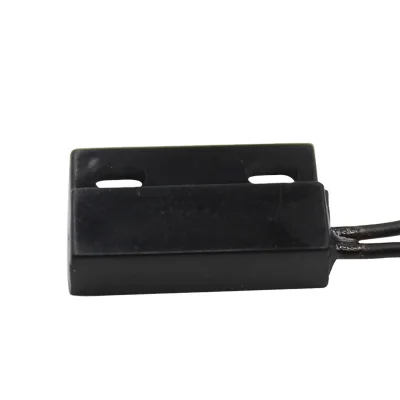
In contrast, wired magnetic sensors, such as the wired rolling/shutter door sensor (ZDD-413MB), are designed for environments where power and data lines are readily available. These units often feature a metal housing made of alloy-zinc, providing superior durability compared to the ABS plastic housing found in many wireless counterparts. The operating distance for these wired units is significantly larger, ranging from 50mm to 70mm, which is advantageous for heavy-duty industrial doors or shutters. The connecting mode for wired sensors is typically configured as Normally Closed (N.C.), though some variants support N.O. (Normally Open) or COM (Common) configurations. The installation method for wired units is often surface mount, utilizing screws for secure attachment, whereas wireless units may be installed outwardly with adhesive or screws depending on the specific design.
Compliance and Certification Verification
In the B2B procurement landscape, regulatory compliance is not merely a formality but a prerequisite for market access and liability protection. Buyers must rigorously verify that suppliers possess valid certifications for the specific regions where the sensors will be deployed. The supplied product data indicates that many manufacturers in this sector adhere to CE and RoHS standards. These certifications are critical for products originating from Shenzhen, China, ensuring that the electronic components do not exceed hazardous substance limits and meet European safety requirements.
Furthermore, some product listings reference ISO certification alongside CE and RoHS, suggesting a broader commitment to quality management systems. However, buyers should exercise caution when interpreting these claims. While the data confirms the presence of CE, ISO, and RoHS markings on specific items, it is the buyer's responsibility to request current, verifiable documentation from the supplier. Relying solely on product descriptions without independent verification of the certification status can lead to non-compliance issues in international trade.
Beyond the basic CE and RoHS markers, specific industries may require adherence to more rigorous standards. For instance, the security industry often references EN50131 standards for intrusion detection systems. Although specific test results for EN50131 are not explicitly detailed in the provided product attributes, buyers should verify if the sensors meet the environmental and electromagnetic compatibility requirements outlined in EN50131-2-6. Similarly, for hazardous environments, IEC 60079-0 standards regarding electrical apparatus for explosive atmospheres may be relevant, though this is less common for standard door sensors. Procurement teams must ensure that the supplier can provide a Certificate of Conformity (CoC) that explicitly lists the standards met, rather than relying on general claims.
Cost Drivers and Pricing Dynamics
The pricing structure for magnetic contact sensors is influenced by several distinct factors, including the technology type, material composition, and packaging requirements. The observed price range in the market spans from $0.10 to $10.00 USD. This wide variance is primarily driven by the distinction between simple wired units and complex wireless RF systems. Wireless sensors, which include the battery, RF module, and integrated antenna, naturally command a higher price point compared to basic wired contacts.
Material costs also play a significant role. Sensors with ABS plastic housing are generally more cost-effective than those constructed from metal alloy-zinc. The metal housing offers enhanced protection against physical tampering and environmental wear, justifying the higher cost for industrial applications. Additionally, the customization availability noted in the product data suggests that buyers can negotiate pricing based on specific branding, color, or functional modifications. However, customization often introduces a Minimum Order Quantity (MOQ) requirement. The observed MOQ range spans from 1 unit to 2,500 units. Small buyers may access single-unit samples, while large-scale industrial deployments will likely negotiate bulk pricing tiers that require orders in the thousands.
Packaging is another cost driver. The data indicates options such as color boxes for individual retail units and standard packing for bulk industrial shipments. The inner packing often consists of 10 sets per PE bag, while outer cartons may hold up to 800 sets. Buyers should consider the logistics costs associated with different packaging configurations, as denser packing reduces shipping volume but may require more handling time.
Typical Applications and Installation Considerations
The versatility of magnetic contact sensors allows them to be deployed across a wide spectrum of applications, from residential homes to specialized industrial equipment. The primary application is for home security, where the sensors monitor windows and doors to detect unauthorized entry. In these scenarios, the wireless nature of the sensors is preferred due to the ease of retrofitting into existing structures without the need for extensive cabling. The low power indication feature, characterized by an LED fast flash, helps users identify battery depletion before the system fails.
In the industrial sector, the requirements shift towards durability and high-capacity monitoring. Wired rolling and shutter door sensors are ideal for warehouses and loading docks where heavy usage is common. The larger operating distance of 50-70mm accommodates the wider gaps found in industrial doors. The metal housing provides resistance to impact and harsh environmental conditions. Furthermore, these sensors are suitable for special equipment and communication electronic products, where precise monitoring of access points is critical for operational security.
Installation requirements vary significantly between product types. Wireless units often feature a "gap for triggered" specification of >15-20mm, allowing for flexible alignment. The installation is typically outward, minimizing the need for drilling into door frames. Conversely, wired units with a 482415mm size profile are designed for surface mounting. The inclusion of screws in the package ensures a secure fit, which is crucial for preventing tampering. Buyers must ensure that the installation method aligns with the physical constraints of the target site, particularly in historic buildings where drilling is restricted or in industrial settings where vibration is a concern.
Supplier Evaluation and Quality Control Protocols
Selecting a reliable supplier is paramount to ensuring the longevity and reliability of the security infrastructure. Buyers should evaluate potential partners based on their ability to provide consistent product attributes and transparent documentation. The data highlights that many suppliers offer a 1-year warranty, which serves as a baseline indicator of product confidence. However, a warranty is only as good as the supplier's ability to honor it. Procurement teams should verify the supplier's track record in handling warranty claims and their capacity for after-sales support.
Quality control should be a central part of the evaluation process. Buyers must request detailed specifications for the alarm current and stand-by current. For wireless units, the stand-by current is observed to be less than 10 microamps, while the alarm current is less than 15 milliamps. These low power consumption figures are critical for battery life. For wired units, the weight is typically around 0.12kg per piece, and the packing size is 75x65x20mm. Verifying these physical attributes against the supplier's claims is a simple yet effective quality control measure.
Furthermore, the integration of the RF antenna and the reliability of the signal transmission must be tested. Buyers should request sample units to conduct field tests in the intended environment to verify the 315MHz/433MHz signal strength and the reliability of the wireless output. For wired units, testing the N.C. / N.O. / COM connectivity ensures that the sensor integrates seamlessly with existing alarm panels.
Long-Term Procurement and Supply Chain Resilience
Long-term procurement strategies for magnetic contact sensors must account for supply chain resilience and product lifecycle management. The observed lead times and MOQs suggest that buyers should plan for bulk orders to secure favorable pricing, but they must also maintain a buffer stock to mitigate potential disruptions. The origin of the products, often Shenzhen, China, presents a logistical advantage in terms of manufacturing capacity but requires careful management of shipping times and customs clearance.
Buyers should also consider the standardization of components. The use of common battery types like CR2032 and standardized frequencies like 315MHz/433MHz facilitates easier replacement and maintenance. However, the availability of customization options means that buyers must be cautious about locking into proprietary configurations that could limit future supplier options. Maintaining a relationship with multiple suppliers who can provide similar specifications ensures that the supply chain remains flexible.
Finally, the evolution of security standards necessitates a forward-looking approach. As the industry moves towards more integrated smart home and industrial IoT solutions, the demand for sensors with advanced features will grow. Buyers should prioritize suppliers who demonstrate a commitment to innovation and compliance with emerging standards. By focusing on technical specifications, verifying certifications, and establishing robust quality control protocols, procurement professionals can secure a reliable supply of magnetic contact sensors that meet the rigorous demands of both home and industrial security applications.
FAQs
What certifications do home industry magnetic contact sensors typically have?
Most units carry CE and RoHS certifications, with some listing ISO standards as well. These marks indicate compliance with European safety and hazardous substance limits, which is essential for international procurement and market access.
How do wireless sensors transmit signals to the alarm system?
Wireless models use an integrated RF antenna to transmit signals at 315MHz or 433MHz frequencies. This wireless output allows for flexible installation without physical wiring, making them ideal for retrofitting existing structures.
Which power supply is used for wireless magnetic door sensors?
Wireless units are powered by a CR2032 button cell battery to ensure long operational life. The system includes a low power indication feature where an LED flashes fast to alert users of battery depletion.
Can buyers customize the color or design of these sensors?
Customization is available for specific branding or functional modifications upon request. However, customized orders often require meeting a Minimum Order Quantity, which can range from one unit up to 2,500 units depending on the supplier.
What is the operating distance for wired rolling shutter door sensors?
Wired rolling shutter sensors typically have an operating distance of 50 to 70 millimeters. This larger gap accommodates heavy-duty industrial doors where alignment might be less precise than in residential applications.
How long is the warranty period for these magnetic contact sensors?
Suppliers typically offer a one-year warranty for the magnetic contact sensors. This warranty serves as a baseline indicator of product confidence, though buyers should verify the supplier's specific after-sales support policies.